…continued from Part-1
Up close, it felt unreal.
All five of them stood in awe.
The crater basin stretched below like a giant amphitheater. The rim rose gently behind them, covered with scrub vegetation and scattered trees. The lake inside the basin reflected the soft orange of the setting sun, appearing calm and almost secretive.
“It’s hard to believe something from space created this,” whispered Ananya.
“It looks like a great sunken bowl carved into the land,” Arjun remarked.
“I feel TINY!”, Meera exclaimed.
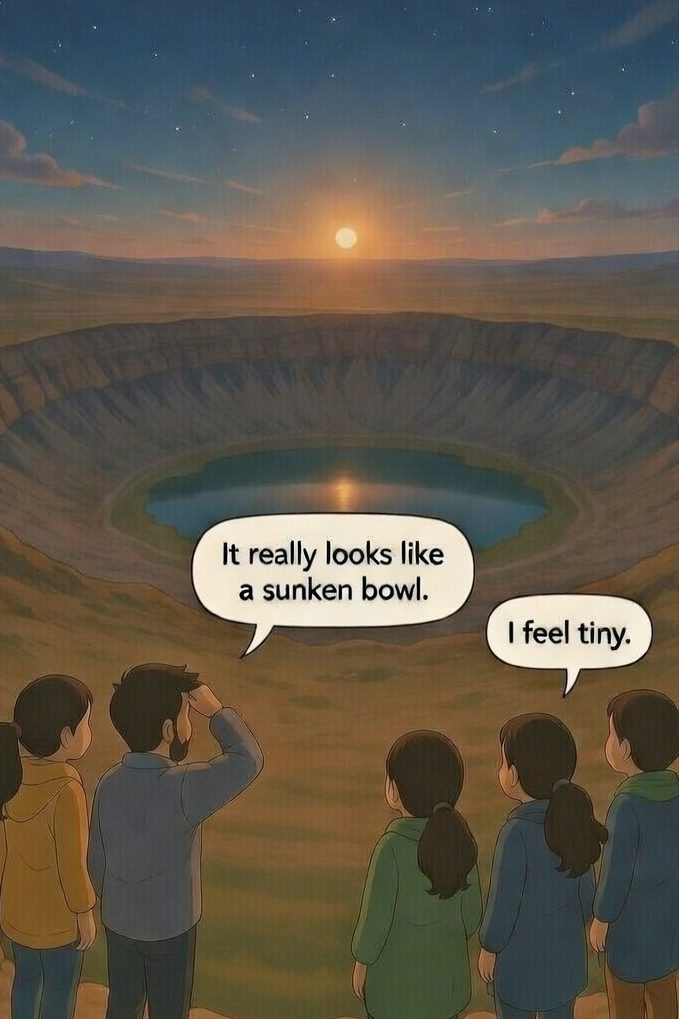
They began walking slowly along the rim. The soil under their shoes felt loose in some patches and rocky in others. Large, fractured stones lay scattered, as though they had once been violently disturbed.
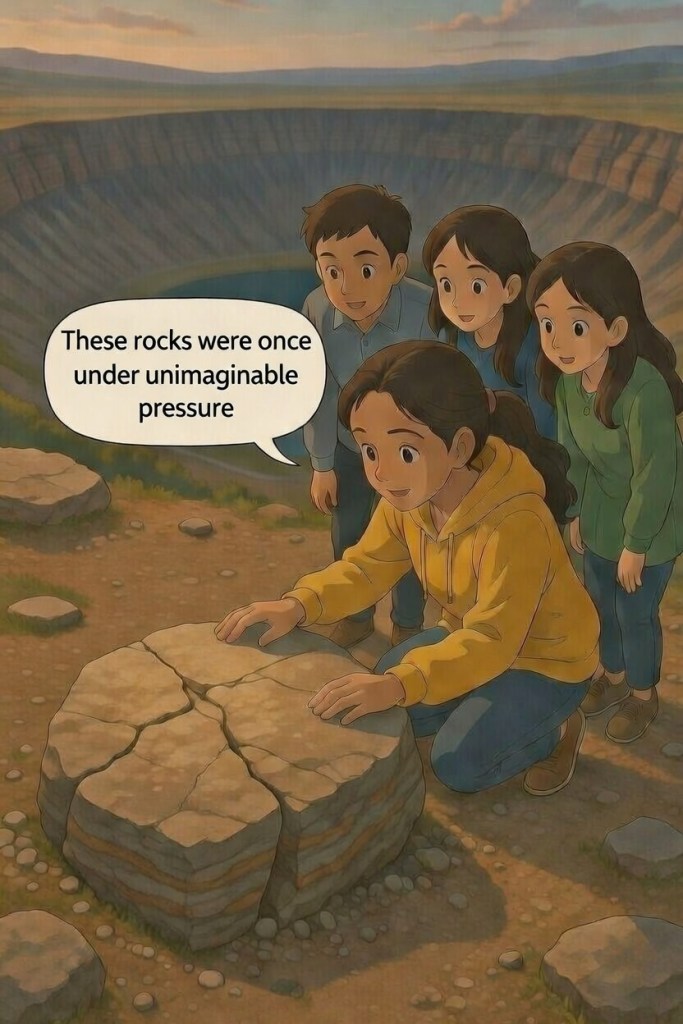
Arjun bent down to examine a rock. “Look at this,” he said. “The layers look slightly twisted.”
Meera nodded. “Impact events create enormous pressure. Rocks behave differently under sudden shock. They can crack, tilt, even rearrange.”
Rohan pulled out a small compass from his backpack. “Let’s try something fun,” he grinned.
“Of course you brought that,” Priya laughed.
He held the compass steady. For a moment the needle trembled before settling north.
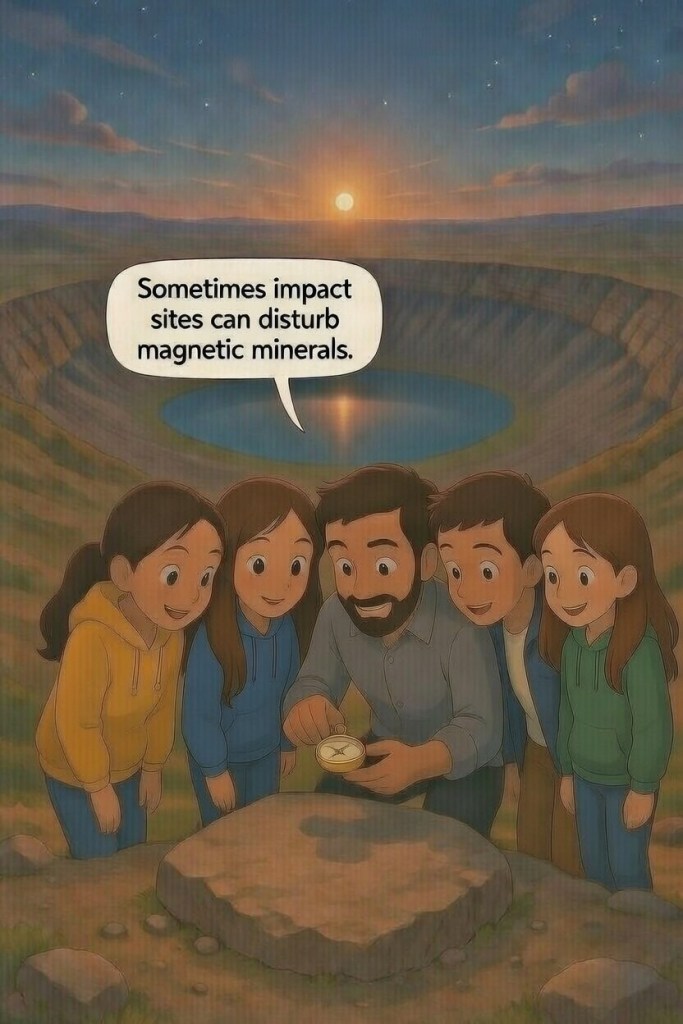
“Sometimes impact sites show slight magnetic anomalies,” Rohan explained casually. “When rocks experience extreme pressure and heat, their magnetic minerals can realign.”
They didn’t notice anything dramatic, but the idea that the ground beneath them had once experienced unimaginable force made them silent for a moment.
They began descending slightly toward the basin. As they moved lower, the air felt different. It was calmer, less windy than the rim. The crater walls blocked much of the breeze.
“Do you feel that?” Priya said. “It’s warmer down here.”
Meera smiled. “Basins can trap air. During the evening, cooler air sinks, but during the day, heat can linger inside enclosed areas like this.”
The lake shimmered ahead of them. When they reached the water’s edge, Ananya crouched and touched it.
“It’s cool,” she said softly.
The water was clearer near the edges, and they could see small ripples forming as the wind skimmed across the surface. The surrounding rocks near the water felt smoother, shaped over time by erosion.
Arjun picked up a small pebble and tossed it lightly into the lake. The ripple spread in perfect circles.
“Imagine,” he said quietly, “millions of years ago, the force that hit here would have sent shock waves in all directions…much stronger than this.”
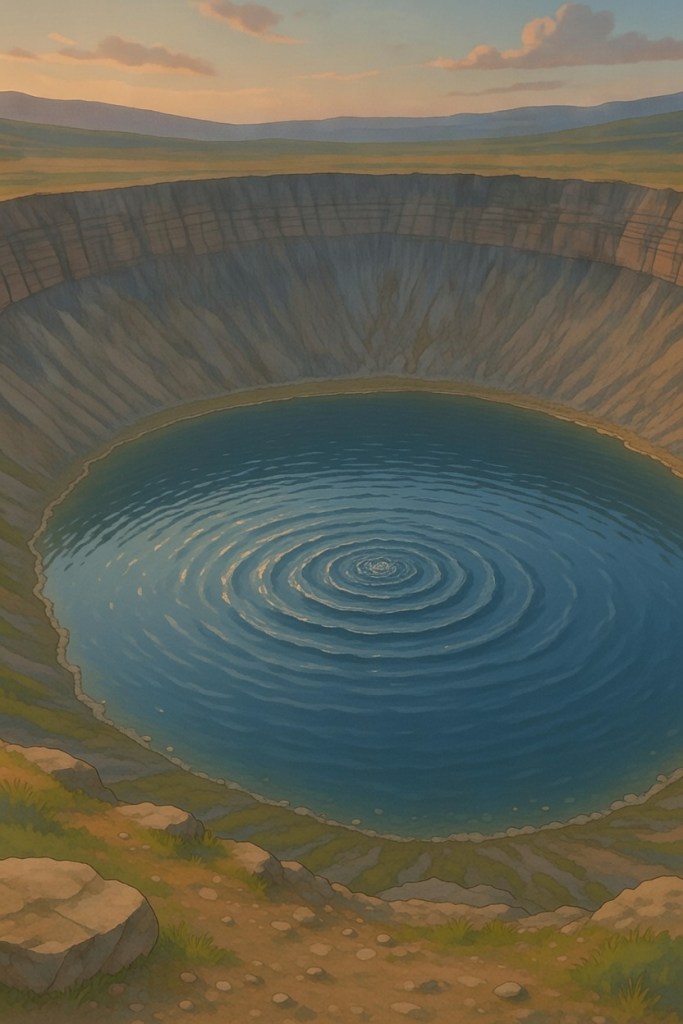
They stood silently, watching the expanding ripples dissolve.
From where they stood, the crater felt ancient. Settled. Almost peaceful.
A faint echo carried when Rohan called out playfully. The sound bounced gently off the inner slopes before fading.
“Even the sound behaves differently here,” he laughed.
The sun dipped lower. The rocky rim cast longer shadows across the basin floor. The temperature began to shift again: not sharply, but gradually. The warmth of the afternoon withdrew, replaced by a soft evening coolness.
They climbed back toward the rim before it got dark. From the top, the crater’s circular geometry was clearer. The symmetry was subtle but undeniable.
Meera took a deep breath.
“We used to travel to feel small,” she said. “And to feel curious.”
Priya added, “And to feel science.”
Rohan looked out toward the horizon where the sky turned violet. “This place has experienced such large heat and pressure. And now it’s quiet.”
Arjun nodded. “Energy transforms. It never disappears. It just changes form.”
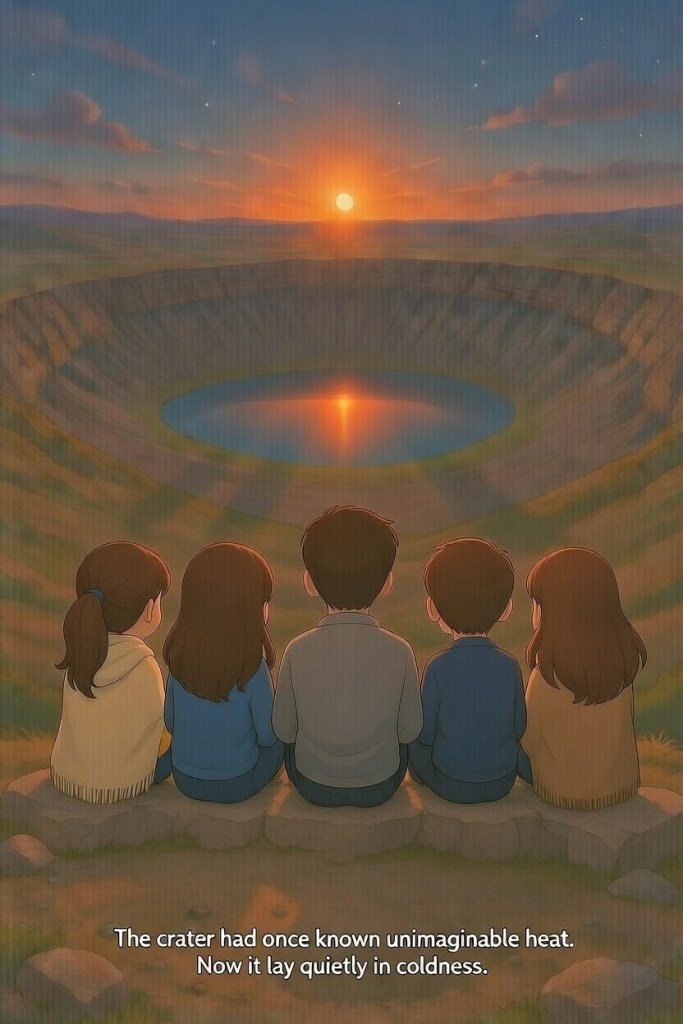
The wind picked up slightly, brushing past them as if agreeing.
They sat there, covered in shawls and jackets, until the first stars appeared. They were in deep thought.
The crater had become a memory decorated with sensations and the quiet hum of Earth’s history.
And somewhere between the rim and the fading light, the five friends felt like their younger selves again. They felt curious, observant, and deeply alive.
WHERE’S THE SCIENCE? Click to find out.
The Ramgarh Crater in Rajasthan was formed millions of years ago when a massive space rock, called a meteorite, crashed into Earth. When something from space hits Earth at extremely high speed, it releases enormous energy. The impact can:
- Break and fracture rocks
- Push rock layers upward
- Create a circular bowl-shaped depression
- Generate extreme heat and pressure
- Sometimes alter magnetic signatures
That is why the crater looks like a giant natural basin.
But that was not the only science they experienced. Science was travelling with them, in heat, wind, water, and their own skin.
- The Hot Tea Priya Couldn’t Lift: The cup felt too hot because heat moves from a hotter object to a cooler one. When Priya touched the metal cup, heat transferred quickly to her fingers. This is conduction. The double cup layer helped act as a temporary barrier between Priya’s fingers and the inner hot cup.
- The Shimmering Fields in the Sun: On the highway, the fields looked like they were shimmering. That’s because hot air rises. When sunlight heats the ground, the air just above it becomes warmer and less dense. Light bends slightly as it passes through layers of different temperatures. That bending of light creates the wavy, watery illusion, called a heat mirage. They weren’t imagining it. The air itself was moving.
- Changing Air Across States: As they drove from Mumbai toward Rajasthan, they felt the air becoming drier. Coastal regions like Mumbai have humid air because they are close to the sea. As you move inland, humidity drops. Dry air feels lighter, causes faster cooling after sunset, and makes sweat evaporate more quickly.
- Sitting Near the Bonfire: At night, sitting near the bonfire felt warm on the side facing the fire, but cool behind them. That’s because fire gives off radiant heat, which travels in straight lines. If you turn away, you block the radiation. Moreover, they insulated themselves with blankets, jackets, and shawls. These layers heat up the air around the skin and hold it there. It also acts as a direct barrier between the cold and the skin.
- The Wind at the Crater Rim: At the rim, the wind lifted their scarves. Inside the basin, the air felt calmer. Large depressions can affect air circulation. Wind flows differently across elevated rims compared to sheltered basins. Land shapes guide air movement.
They experienced science in varied ways, such as:
- Fingertips pulling away from heat
- Eyes squinting in bright light
- Skin drying in desert air
- Shoulders hunching against wind
- Hands stretching toward fire
Want to experience something similar?
1. Fill a tray with flour and sprinkle a thin layer of cocoa powder or colored sand on top. Drop a small stone from different heights.
Observe:
- The circular shape
- The raised rim
- How material spreads outward
Try dropping from higher up. How does the crater change?
2. Take a trip to a nearby place where a scientific event has occurred/occurs. Closely observe your journey and the event. Take your friends/family and explain to them!
Alternative: If you can, visit: An open hilltop AND A small low-lying ground nearby. Stand quietly in both. Does the wind feel different?
3. Step outside barefoot, just before sunset, and then again 30-45 minutes after sunset. Notice how quickly the air cools, especially in dry areas. Remember: Land and air release heat at different speeds.
4. Sit near a heater or bonfire (with supervision). Turn one side of your body toward the heat.
Notice:
• One side feels warm
• The other side feels cooler
 Embodied Science Stories