Do any of us really remember how we started liking something?
A favorite football league team… rocking to all the lyrics of Linkin Park’s Crawling in My Skin… borrowing an AC/DC shirt with no idea how famous they were… or the numerous space games you played on the PC : Mars Rover, Space Invaders, and then the sci-fi movies!
Well, for Pema, it was her older brother who introduced her to all the unclaimed and so-called “forbidden” territory for girls her age.
This was the early 2000s. Most of her friends who did not have a brother were not aware of any of the movies, games, or bands that Pema was already well-versed in.
It was a lazy Sunday.
Pema was loitering around the house. It was one of those days when nothing seemed left to do. The parents were relaxed, doing their own things, reading a book or watching TV, and, for once, siblings were not quarrelling.
Such afternoons felt like surfing on a gentle wave, arms stretched out, eyes half-closed, warm sunlight and wind brushing through your hair.
Pema, scrolling through her comic, glanced at her brother. He was playing a game on their white personal computer.
“Can we play movies on this computer?” she asked.
Her brother shrugged.
“Music CDs work… so I guess DVDs should work too.”
Pema quickly seized the moment.
“Can we watch one this afternoon?”
To her surprise, the calm afternoon continued its magic. Her brother agreed to go ask their mother for permission to rent a movie.
And again, to their surprise, their mother agreed. She even handed him a few bucks to get one from the movie rental shop.
Her brother grabbed his cycle and set out for the shop.
Pema waited.
She looked out from the balcony. The lane outside was empty. Not a single soul.
She went back to her comic, legs hanging over the edge of the wall. But her mind was racing.
Which movie will he get?
Will he find anything?
What if he comes back empty-handed?
What if it doesn’t work on the computer?
“Aargh,” she sighed. She could hardly contain the excitement.
Finally she slipped into her slippers and quietly stepped outside.
She paced back and forth along the lane beside her house, constantly looking toward the main road.
After about fifteen minutes, and endless pacing, she spotted a familiar red cycle appearing from the end of the lane.
She ran back upstairs quickly, pretending to read her comic before her brother arrived.
Her brother entered, sweat on his forehead and T-shirt damp from cycling.
He lifted a thin plastic-covered CD case and handed it to her.
“I found this movie. Let’s see if it works.”
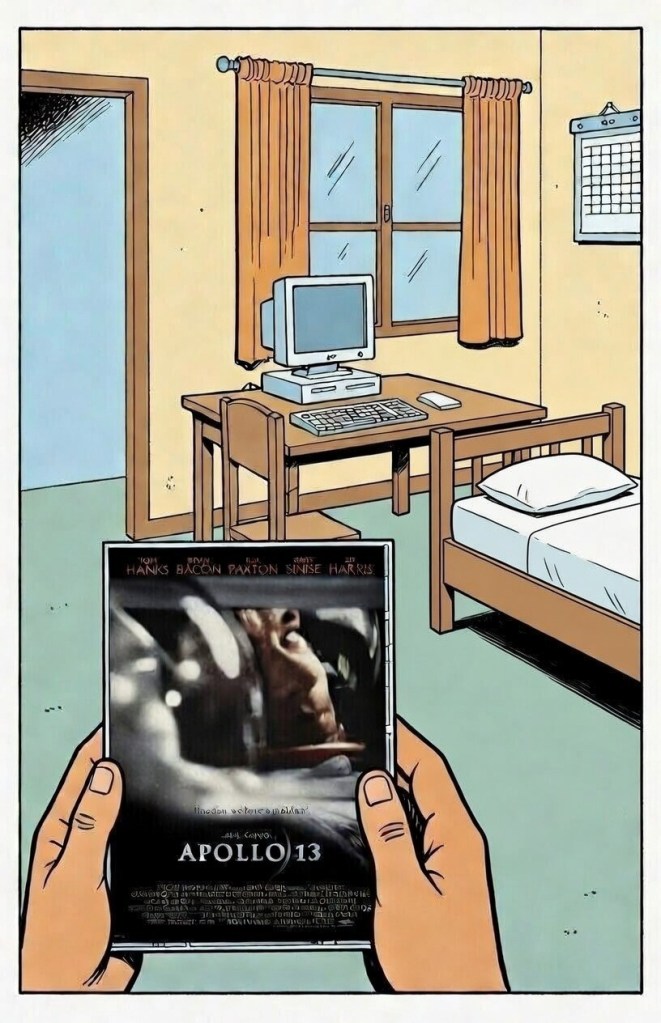
Pema grabbed the CD and studied the cover carefully.
It showed a man’s face inside a spacesuit, with a large image of the Moon beside him.
She tilted her head.
“Apollo 13? But I’ve only heard of Apollo 11… what did Bhai get?”
She inserted the DVD into the computer, not expecting it to work.
Miraculously, the movie began playing. A faint sound crackled from the small computer speakers.
Her brother sat at the study table in front of the computer. Pema sat on the edge of the bed nearby.
At first she barely understood what was happening. She kept interrupting the movie with endless questions.
“But didn’t they already go to the Moon? Why did they want to go again?”
“To get more answers about the Moon,” her brother replied briefly.
“Isn’t 13 an unlucky number? Why did they name it that?”
“Because they are scientists,” he replied casually.
Pema continued asking questions until suddenly the story gripped her attention.
Three days into the mission, an electrical short caused a tank to explode, damaging the spacecraft.
Pema began biting her nails.
“What will happen now? Will they just keep flying until the fuel runs out? They won’t land on the Moon anymore!”
Then she heard the flight director say:
“Failure is not an option.”
They would do everything possible to bring the astronauts back.
Now Pema was completely hooked.
The astronauts had moved into the lunar module, which was never designed to support so many people for so long. Everything looked like a puzzle filled with impossible constraints.
What would happen next?
She watched in amazement as the NASA engineers on Earth designed an improvised device using the same materials available in the spacecraft to prevent carbon dioxide poisoning.
But what fascinated Pema even more was the slingshot maneuver they planned to use to return to Earth.
Swinging around the Moon? Using the Moon’s gravity?
How could that work?
The only slinging she could imagine was swinging a stone tied to a rope… or sometimes spinning her purse… or even twisting a bedsheet.
How could they use the Moon’s gravity?
“Bhai, how can the Moon’s gravity help them come back?” she asked.
Her brother rotated his arm in a circular motion.
“It’s like swinging a stone around your head like this.”
Pema frowned.
“Does the stone use our gravity? That doesn’t make sense.”
Her brother waved his hand casually.
“If I want to move something from here to there without using more energy, sometimes going around is easier.”
“Oh! Rotating around increases the force and… speed!” Pema exclaimed proudly.
“Yeah, yeah… something like that,” her brother replied absent-mindedly.
Then he grabbed his cricket bat.
“I’m going to play cricket. You continue watching.”
“Are you sure?”
“Yes.”
And off he ran.
Now Pema moved to the centre chair in front of the computer.
She folded her legs and sat closer to the screen.
As she watched the astronauts approach the Moon, she heard the ground control team discussing how they would fly near the Moon, not land, and use its gravity to help circle back toward Earth.
Pema paused the movie.
She stood up.
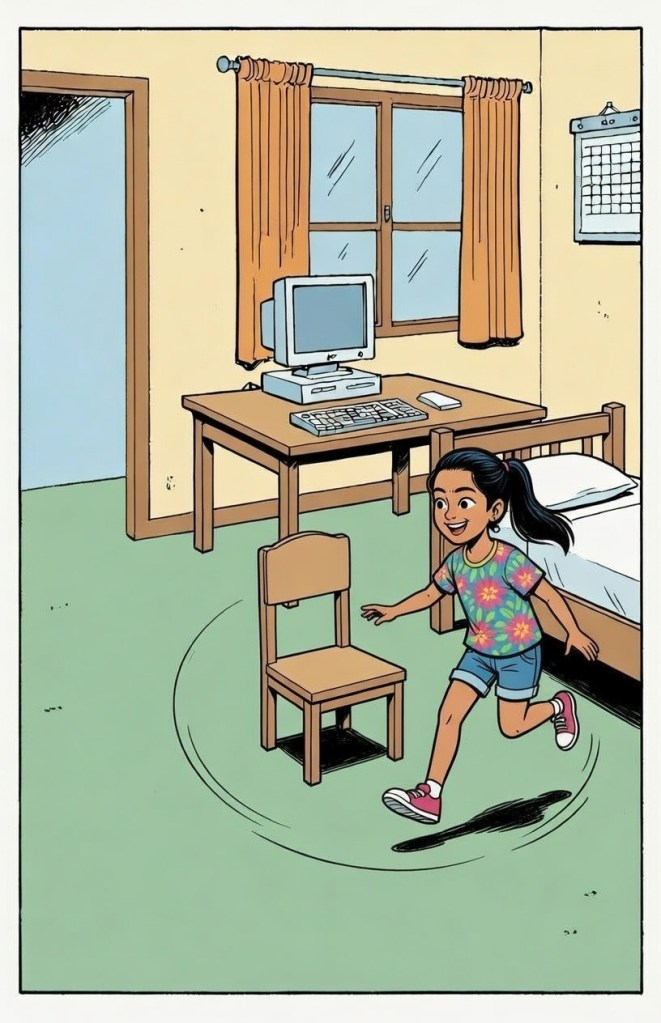
Then she dragged the chair into the middle of the room.
She walked toward the chair… then stepped away.
She murmured to herself,
“So if I go near the chair, the gravity increases… and if I move away, the gravity decreases.”
Then she walked around the chair in a curve.
“And if I go near and around… I can use that pull to move around and out!”
Pema stopped.
She had just demonstrated the idea to herself.
She felt thrilled that she understood it.
She resumed the movie.
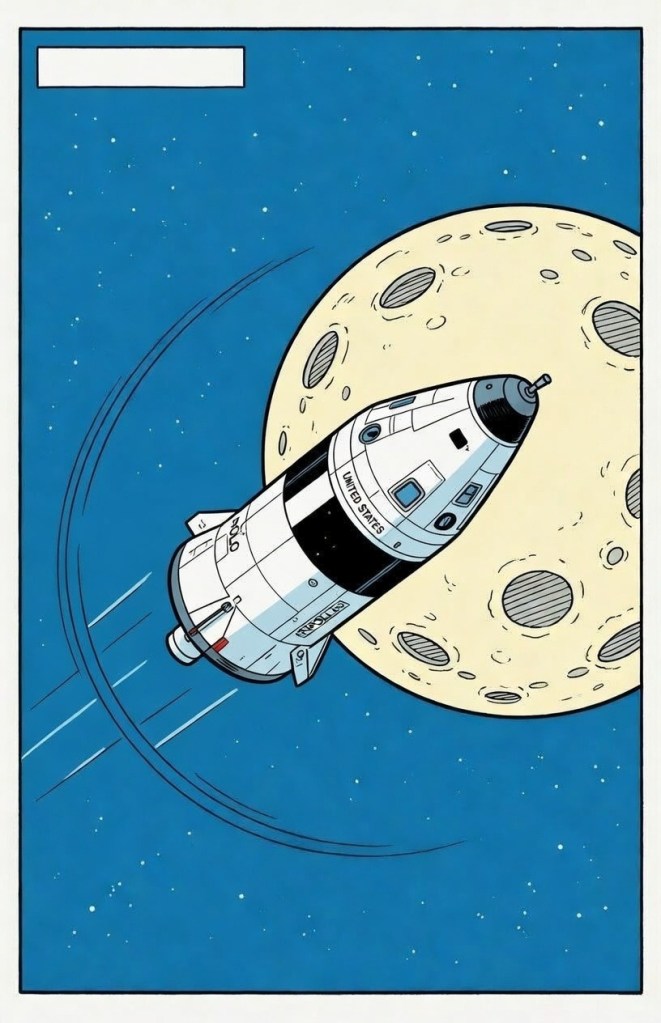
The spacecraft curved around the Moon.
Pema imagined how the astronauts must have felt…coming so close to the Moon yet not landing on it after months of preparation.
She admired their courage, and the determination of the entire NASA team.
The thought of flying in a rocket and missing Earth completely, just continuing into endless space…was unimaginable.
The idea terrified her.
The fastest thing she could picture herself in was a car, racing past a house instead of stopping at it.
Finally, the capsule began its return to Earth.
The heat shield glowed. The spacecraft burned through the atmosphere.
For a few tense minutes, communication was lost. The heat, the burning up of the shuttle, the damage, there was no chance of them being back.
Pema held her breath.
Then suddenly
The astronauts splashed safely into the ocean.
Alive.
Pema jumped up and clapped loudly.
It felt as if she had been right there with them through the entire journey.
That Sunday afternoon slowly merged into evening.
This unexpected afternoon of the movie was going to stay with Pema for quite a long time.
It was the first time she had felt the thrill of understanding something about space with her own mind… by walking around a chair in her room and imagining the pull of the Moon.
Pema would watch many more space movies, read books about astronauts, and learn about gravity, orbits, and spacecraft over the years.
But every once in a while, her mind returned to that quiet Sunday afternoon, a white computer, a rented CD, and a thrilling moment when the Moon’s gravity suddenly made sense in the middle of her room.
WHERE’S THE SCIENCE? Click to find out.
While watching the movie, Pema kept wondering how the astronauts could “use the Moon’s gravity” to return to Earth.
To make sense of it, she paused the movie, dragged a chair to the middle of the room, and began walking around it. As she moved closer to the chair and curved around it, she imagined the chair as the Moon and herself as the spacecraft.
- Understanding the slingshot
In the Apollo 13 mission, the spacecraft could not land on the Moon. Instead, NASA planned for it to fly close to the Moon and swing around it, using the Moon’s gravity to bend its path and send it back toward Earth.
Pema’s little experiment with the chair helped her imagine this idea. By moving near the chair and curving around it, she pictured how the spacecraft could approach the Moon, feel its gravitational pull, and then swing away in a new direction.
- Changing the Path (Trajectory)
When Pema walked straight across the room, her path was simple and direct. But when she moved closer to the chair and circled around it, her path curved.
Something similar happens to spacecraft in space. When they pass near a massive body like the Moon, gravity pulls on them and changes their trajectory, or path of motion. Instead of continuing straight, their path bends, just like the path Pema imagined while walking around the chair.
In that small corner of her room, Pema turned a confusing idea from a movie into something she could see, move, feel, and understand with her own body.
Want to experience something similar?
Make a Mini “Gravity Well”
Take a large bowl and place it upside down on a table. Now roll a marble or small ball across the table so it passes close to the bowl.
Try rolling it from different angles and speeds.
Notice how the marble’s path curves as it moves around the bowl instead of going straight.
Imagine the bowl is the Moon and the marble is the Apollo spacecraft. As the spacecraft comes near the Moon, gravity pulls it and bends its path, helping it swing around and continue toward Earth, just like the slingshot maneuver Pema was trying to imagine in her room.
 Embodied Science Stories