Advisory: This story contains imaginary elements and explores themes of fear. Parental guidance is recommended where appropriate.
Asha was a jovial girl. She pranced around the village and was quite energetic. Her parents were always worried that she would get into trouble because she was always finding ways to keep herself and the villagers entertained. The village, an arid one bordering a small town, was well known for its silver works. All the villagers were involved in one job or another like designing silver artifacts or transporting it to the cities. Everyone was content with how life was. They managed a comfortable living and were mostly happy.
Asha had many plans of her own. She dreamt of building a designer silver earring store. She spent a lot of her time daydreaming about this. But she was only six. She had years ahead of her before she could actually do it. Still, she was determined. She never missed any opportunity to learn about silver. Hence, she always made it a point to visit her favorite uncle, Uncle Mandia’s workshop, where they made decorations with silver coatings.
She picked up her jhola and jumped and swayed in the hot afternoon, on her way to pester her uncle. Asha was humming the village song, “aye barasa asila dekha, mana jhumi jaye dekha..(translation: see the rain has come, my mind is dancing, see)” when she noticed something. Rather something odd. Everyone and everything in the village was unusually quiet that day. She stopped and looked around. Everyone’s face had an expression of impending doom. They were worried and kept cursing the sky. Surprised, she quickened her pace and reached Uncle Mandia’s workshop.
As usual, like she does every day, she stood behind the door to scare her uncle. When he appeared, she jumped, “Boooo! Hahaha!”
To her surprise, uncle Mandia did not react as usual, “Oh, Asha, you! Stop doing that.”
A little disheartened, Asha stepped in and asked, “What happened, uncle? You look worried.”
“Oh, it’s nothing. I am a little busy, so go away. I will talk to you later,” Uncle Mandia shooed her away and continued his work.
Asha was almost on the verge of crying. It had never happened until that day that Uncle Mandia had spoken that way, and that too, he did not let her in the workshop. Asha assumed that there was something that Uncle Mandia was definitely worried about; he would never do that. She thought of going in and asking, but then decided against it, worried that she might trouble him.
Still thinking about the villagers cursing at the sky, her uncle’s indifferent reaction, and the gloomy atmosphere spread in the village, she went near the lake to sit and throw some pebbles. As she reached, she saw that the shrubs were uprooted weirdly, and a few bits of shining pebbles were scattered around. When she reached closer to the lake, she realized that they were not pebbles but pieces of silver.
“Silver? Why are they here? Nobody would leave them this way!” she spoke aloud to herself. She quickly turned around and decided that it was best to go home now.
During dinner that evening, she observed that her parents were quiet. Normally, they would passionately discuss something or the other, be it about elections, the education system, or, obviously, silver. But that day, they were just eating.
Asha finally spoke. “You know, Ma, I saw pieces of silver near the lake.”
Her mother gasped. Asha’s father held her mother’s hand and said, “It’s nothing, Asha, some people must have discarded them along with other rubbish by mistake.” He got up immediately and washed his hands. All of them cleared their plates and cleaned the kitchen quietly.
Asha went to her room and picked up her comic book. She could see that her parents were whispering something. She went stealthily and tried to make sense of what they were saying.
“You have to be careful, Asha must not know, “ Her father whispered to her mother.
“But I am scared, I don’t know what will happen”, replied her mother
“Shh… trust the forests. They will protect us. Let us discuss further when we reach the village centre tonight.”
Asha quickly went back to bed and forcefully shut her eyes, clutching her bedsheet tightly over her head. Her father came to check if she was asleep and turned off the lights. But Asha did not sleep. She decided that she must stay awake and find out what is going on.
After an hour or so, Asha’s parents, very quietly, took the lantern, stepped out, and closed the door behind them.
Asha waited for 5 minutes and then got up, put on her sweater, took a torch, and immediately left behind her parents.
After about 15 minutes of walking, she saw her parents, along with many other villagers, reach the village centre. She waited outside until the coast was clear. Once everyone was inside the centre, she ran towards the centre hall and stood near the window to listen.
Inside the centre hall, people were quarrelling, some wailing others gasping.
“But how did this happen?!” exclaimed the Sarpanch.
“How should I know, I am as shocked as you are!”, replied the Deputy Sarpanch.
“Please do something Sarpanch ji, else we have to leave the village and our homes”
“I thought this was only a myth. How did it become true? That too after 1000 years”, wondered a villager.
“I always saw that red colored ant eating the sugar offerings to the Gods and going back to the colony. I never knew it would turn out to be such a such a ….Oh! God, I can’t even say its name without chills running down my spine…THE GIANT!” interjected another villager.
Asha gasped. “What were they talking about? Was it an actual Giant? Like a big creature!?”
The villagers continued discussing. “But how can an ant grow into such a giant and create havoc in our lives, all of a sudden!? The times are already tough as it is. This is just unbearable. Oh! God, I can’t take this anymore,” wailed an old man sitting in a corner.
“Please, everyone. You must not lose hope. Let us think what we can do”, Asha’s mother interrupted the worried atmosphere.
“But what can Hope do? We cannot fight against that big, huge, red stone of a giant. Even if all of us fight together with all that we have,” objected a villager.
“Maybe not, but we can try. If all of us stick together, use our heads, we can gather enough strength and courage to fight that red beast,” replied Asha’s father.
There was a slight change in the villager’s face after this. They were still scared. But they were now hopeful too.
“Okay, let us think about what we can do. In the meantime, please keep our children and cattle safe. Let us disperse. It has been a long night,” declared the Sarpanch.
Asha was now worried, scared, and intrigued with hundreds of questions. She quickly rushed back to her house before her parents saw her.
That night, Asha had vivid dreams. She dreamt of a huge red ball tumbling down a hill and all of her silver earrings scattered on the ball’s path. Asha ran towards the hill to stop it, but the more she ran, the longer the hill became and the bigger the ball turned into.
Asha woke up abruptly from the nightmare and sat on her bed. It was already way past sunrise.
That day passed in Asha’s imagination. Asha kept imagining how big the giant was, what it looked like. She even went to the outskirts to see if she could find anything. Near multiple anthills, she saw a big footprint hidden beneath the leaves. Asha was amazed. She examined the footprint, looked at the ants, and the anthills. Scared and worried, she immediately returned home.
The gloomy atmosphere continued. That night everyone retreated early into their homes, prayed and were ready to enter their world of dreams. Just then a loud booming voice teared through the still night sky.
*RAWRRR* *THUD* *CRASH*
“Ma, Baba, what was that?,” Asha ran towards her parents.
They looked outside the window and saw a large shadow moving. The ground was trembling. Then Asha saw. A Big Red Giant stomping on the ground, destroying everything on the way, uprooting trees, scratching the walls, and making holes in the ground.
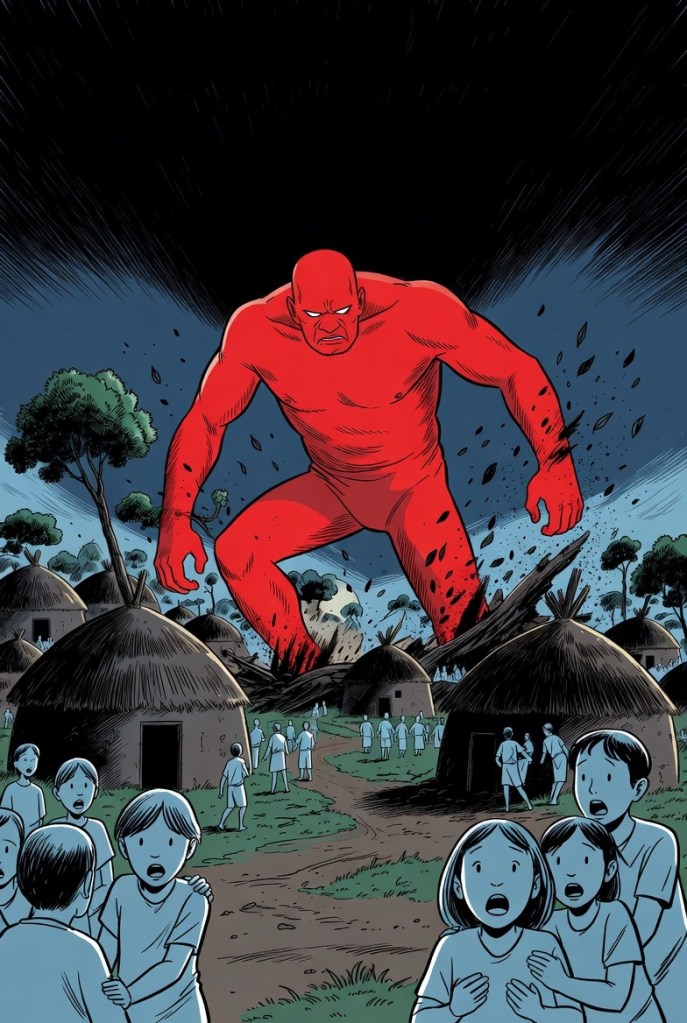
Asha, Ma, and Baba turned off all their lights and hid inside, clutching each other in the dark, waiting for the giant to pass.
“Baba, can’t we do something about the giant? How can we live like this?” asked Asha.
“But what can we do? We are not able to think of anything other than leaving the village,” replied her Baba.
“The way it grew in the first place”, Asha immediately replied.
“What do you mean?” Asha’s mother was shocked by the information Asha had.
“I know, Ma, I know Baba, I am sorry I followed you last night. But please listen to me, I have an idea,” Asha pleaded.
Asha whispered into her parents’ ears. Initially, her parents were surprised, but slowly their eyes turned hopeful, and they smiled.
“I think this might just work. If not to tackle the giant, but at least to keep the villagers hopeful,” Asha’s Baba encouraged her.
The next day, Asha began her mission. She started with her usual pranks, making people laugh with silly faces, scaring her uncle Mandia, and singing loudly while others were quietly working. At first, everyone was silent and surprised, unsure why Asha would behave this way at a time like this. But gradually, they eased into it. A chuckle slipped out here and there whenever she pulled a funny face or sang the familiar songs of their village.
That night, the Red giant appeared again, with its usual roaring, uprooting, and scaring. All the villagers had gathered in the village centre that night.
Asha pointed out, “Don’t you think it has shrunk? See, before it used to overpower that tree, but now it is just the same height as the tree. Look, look!”
“Ah, I can’t really make any difference”, replied Uncle Mandia.
“Oh, we are doomed. We have to leave the village, there is no other way”, cried multiple villagers.
A new panic and worry spread through the centre. Asha was sad. She thought her idea of making the villagers happy would work.
A few days passed. Some villagers had already started leaving and everyone was awfully silent, hiding and quietly doing their work and retreating to their homes, closed shut, no contact or gathering with anyone.
And the red giant. It was now almost double the size of the trees. Every night that it emerged, it was larger than before. Only a few steps were enough to cause damage to the forests.
Asha was now more than determined to deal with this problem. She thought of an idea. “What if I co-ordinate a singing collaboration tonight?”
“But none will come out now, they are more scared than ever”, her mother added.
“I think I know what to do about it.” Asha’s eyes twinkled. She ran to her uncle Mandia.
“Uncle, uncle, I really need your help, please don’t say no”, Asha pleaded.
Asha told her idea to Uncle Mandia.
They collected copper wire from old motors, magnets from broken radios, and paper plates, then built many small speakers that could vibrate and make sound.
Using pencil lead from school pencils and thin plastic sheets, they also made simple microphones that could pick up voices.
By connecting these with scrap wires across houses, they set up many sets so the whole village could sing and play faint music together at night.
Asha then went to these houses and pleaded with them to use it that night to sing the village song. Many of them hesitated, but since Asha was so keen, they assured her that they would.
Asha waited for the moon to peak that night. She then positioned herself near her microphone and adjusted her speakers:
“Aame sabuthi eka swore gaau, Andhaara raatire aaloka jwalaau,
Haate haata dhari aagaku chaalu, Aashaara sure nua prabhaata gadhu.”
(Translation: We all sing together in one voice, Lighting a glow in the dark night,
Hand in hand we move forward, Building a new dawn with the tune of hope.)
At first, only her voice pierced weakly through the night. Then another joined in, and soon several more, some feeble, some strong, until the entire village was booming with song.
Then, the villagers started to emerge from their homes. They held their hands together and started swinging in unison, dancing with hope and joy.
The red giant surfaced from the darkness, but to everyone’s surprise, it was shrinking. It shrank to the size of the tree, then a person, then a boulder, and finally into a small red ant. The red ant immediately ran back to its anthill.
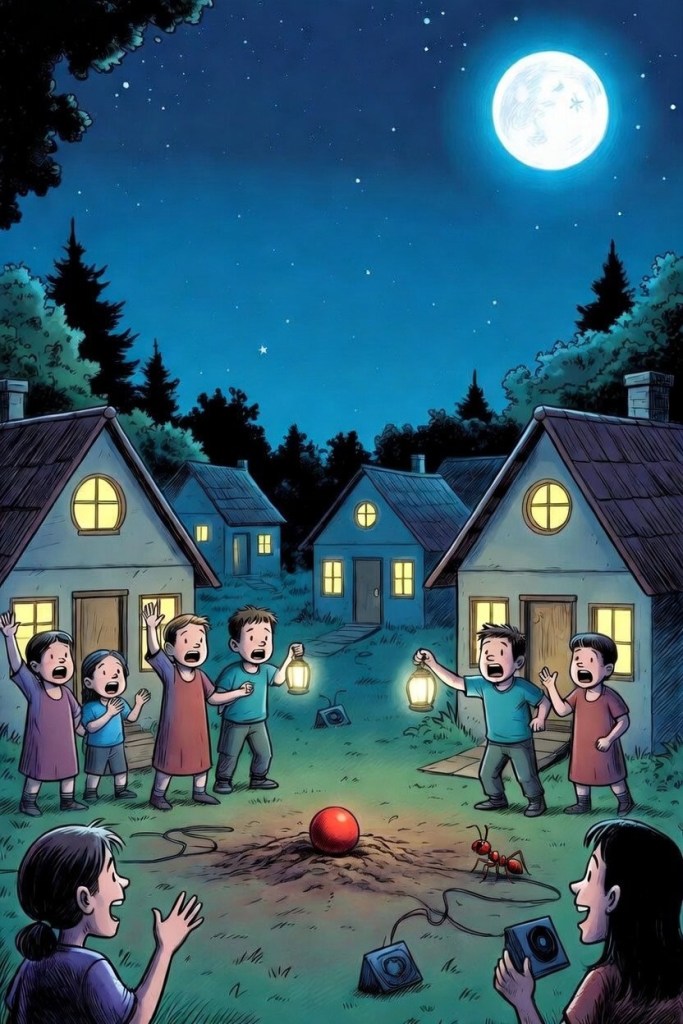
Everyone rejoiced. They lifted Asha on their shoulders. Their joy now multiplied. They could now live without fear. They did not have to leave their homeland.
In the days that followed, the village slowly returned to its rhythm. The workshops reopened, the laughter came back, and the silver once again shone in the sunlight.
But the villagers had now seen how fear could grow, until it felt like a giant. And they had also seen how hope, courage, and togetherness could slowly bring it back down.
Asha did not fully understand everything that had happened.
But she knew one thing for sure. Sometimes, the biggest giants are not fought with strength, but with voices that come together, hearts that stay brave, and people who refuse to give up on each other.
And whenever the village felt a little too quiet again, Asha made sure to sing just a little louder.
WHERE’S THE SCIENCE? Click to find out.
The ‘giant’ was a creature born of fear and imagination, amplified by isolation and countered through the villagers’ physical and social actions.
This was an imaginary story. But did you see bits of science in the fiction?
- Fear and the Growing Giant
Asha physically felt her heart racing, her hands clutching the bedsheet, and tiptoed to watch the villagers whisper. That rising fear spread from one person to another, growing larger in the village’s imagination, just like the “giant” seemed to grow. This is how collective fear amplifies perception, and how our body sensations (fast heartbeat, tense muscles, racing thoughts) can make a situation feel bigger and scarier than it really is.
- Sound Waves and Vibrations
When Asha set up the microphones and speakers, she felt the vibrations under her hands and chest as her voice traveled through the wires and speakers. Each person’s singing added layers of vibration, and together the entire village felt the sound moving around them. This is embodied physics: sound is energy traveling through air, creating pressure waves that can be felt as well as heard, shaping the environment and even influencing mood.
- Collective Action and Body Coordination
The villagers joined hands, moved together, sang, and swung in unison. Their bodies literally acted as amplifiers of energy and rhythm, making the village-wide vibration stronger. The giant, which grew from fear, shrank as the villagers’ coordinated embodied actions countered it. This shows how physical movement, rhythm, and group coordination can transform perception and create a real sense of power and safety.
Want to experience something similar?
Fear Amplification Experiment
What you need:
- A small group of friends or family
- A dimly lit room or outdoor space
- A small object to hide or reveal (like a toy)
What to do:
- One person hides the object and whispers to the others that it is “scary” or “unusual.”
- Each participant reacts naturally, describing what they feel in terms of heartbeat, tension, breath, etc.
- After each person reacts, observe how fear seems to grow with each reaction, just like the giant grew with the villagers’ fear in the story.
Our body sensations (heart rate, breathing, muscle tension) amplify perception. Fear can spread through a group, making things appear bigger or scarier than they really are.
 Embodied Science Stories